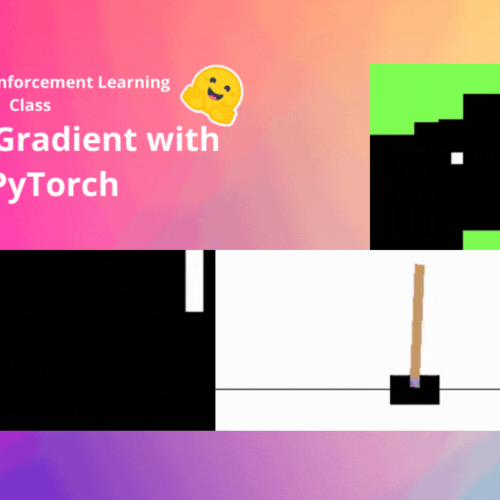
Understanding Policy Gradient with PyTorch for Reinforcement Learning
Delve into Policy Gradient methods with PyTorch to optimize policies directly in reinforcement learning without relying on value functions, aiming to democratize AI through open-source and open science.
Published 3 years ago on huggingface.co
Abstract
This article explores Policy Gradient methods, focusing on Reinforce, a Policy-Based algorithm, implemented using PyTorch. It compares the advantages of Policy-Gradient over Deep Q-Learning, highlighting simplicity, stochastic policy learning, and effectiveness in high-dimensional and continuous action spaces. However, it also discusses challenges like local maxima convergence, training inefficiency, and high variance in Policy-Gradient methods.
Results
This information belongs to the original author(s), honor their efforts by visiting the following link for the full text.
Discussion
How this relates to indie hacking and solopreneurship.
Relevance
This article is crucial as it introduces Policy-Gradient methods, particularly Reinforce, empowering you to directly optimize policies for your projects without the need for value functions, highlighting opportunities to improve exploration, handle complex action spaces, and enhance learning efficiency.
Applicability
You should implement Policy-Gradient methods like Reinforce using PyTorch to optimize policies directly, especially in scenarios with high-dimensional or continuous action spaces, to enhance exploration and learning efficiency in your reinforcement learning projects.
Risks
One risk to be aware of is that Policy Gradient methods can converge to local maxima, leading to suboptimal solutions. Additionally, these methods may require longer training times and exhibit high variance, impacting the stability and efficiency of learning processes in your projects.
Conclusion
Understanding and implementing Policy Gradient methods like Reinforce can position you to tackle complex reinforcement learning tasks efficiently. Future trends may see advancements in optimizing Policy-Gradient algorithms to mitigate local maxima convergence and improve training efficiency, offering more robust solutions for AI applications in diverse domains.
References
Further Informations and Sources related to this analysis. See also my Ethical Aggregation policy.
Policy Gradient with PyTorch
We’re on a journey to advance and democratize artificial intelligence through open source and open science.
AI
Explore the cutting-edge world of AI and ML with our latest news, tutorials, and expert insights. Stay ahead in the rapidly evolving field of artificial intelligence and machine learning to elevate your projects and innovations.
Appendices
Most recent articles and analysises.

Discover how AI-focused fintech companies secured 30% of Q2 investments totaling $24 billion, signaling a shift in investor interest. Get insights from Lisa Calhoun on the transformative power of AI in the fintech sector.

Amex's Strategic Investments Unveiled
2024-09-06Discover American Express's capital deployment strategy focusing on technology, marketing, and M&A opportunities as shared by Anna Marrs at the Scotiabank Financials Summit 2024.

PayPal launches a new rewards program offering consumers 5% cash back on a spending category of their choice and allows adding PayPal Debit Card to Apple Wallet.

Explore the significance of gender diversity in cybersecurity, uncover key statistics, and track the progress made in this crucial area.

Discover how Docker and JFrog collaborate to boost secure software and AI application development at SwampUP, featuring Docker CEO Scott Johnston's keynote.

Discover the innovative hospitality experience at Marriott Long Beach Downtown, blending warm hospitality with Southern California culture in immersive settings.